|
|
|
|
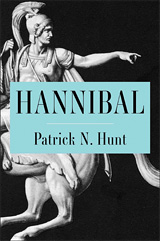
HANNIBAL 2017
Simon and Schuster
One of the greatest commanders of the ancient world brought vividly to life: Hannibal, the brilliant general who successfully crossed the Alps with his war elephants and brought Rome to its knees.
Hannibal Barca of Carthage, born 247 BC, was one of the great generals of the ancient world. His father, Hamilcar, was also a great strategist and master tactician who imposed Carthaginian rule over much of present-day Spain. After Hamilcar led the Carthaginian forces against Rome in the First Punic War, Hannibal followed in his father’s footsteps, leading Carthage in the Second Punic War.
From the time he was a teenager, Hannibal fought against Rome. He is famed for leading Carthage’s army across north Africa, into Spain, along the Mediterranean coast, and then crossing the Alps with his army and war elephants. Hannibal won victories in northern Italy by outmaneuvering his Roman adversaries and defeated a larger Roman army at the battle of Cannae in 216 BC. Unable to force Rome to capitulate, he was eventually forced to leave Italy and return to Carthage when a savvy Roman general named Scipio invaded north Africa. Hannibal and Scipio fought an epic battle at Zama, which Hannibal lost. The terms of surrender were harsh and many Carthaginians blamed Hannibal, eventually forcing him into exile until his death.
To this day Hannibal is still regarded as a military genius. Napoleon, George Patton, and Norman Schwarzkopf, Jr. are only some of the generals who studied and admired him. His strategy and tactics are still taught in military academies. He is one of the figures of the ancient world whose life and exploits never fail to impress. Historian Patrick N. Hunt has led archeological expeditions in the Alps and elsewhere to study Hannibal’s achievements. Now he brings Hannibal’s incredible story to life in this riveting and dramatic book.
Available at:
Amazon.com
Barnes & Noble
BAM (Books A Million)
Indie Bound
Release date July 2017. |
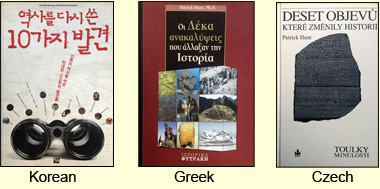
This best seller is now in five languages, including Korean, Greek and Czech. |
|
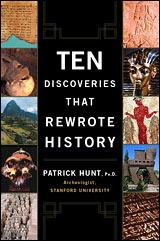
TEN DISCOVERIES THAT REWROTE HISTORY 2007
"If any global archaeologist were asked to name the top ten archaeological discoveries that have made the greatest impact on archaeology and history, most lists would be likely to unanimously mention the following huge impact discoveries: the Rosetta Stone, Pompeii, Nineveh, Troy, King Tut's Tomb, Machu Picchu, Thera-Akrotiri, the Dead Sea Scrolls, Olduvai Gorge starting with the Leakey Era and the Tomb of the Ten Thousand Warriors in China. This exciting book, written with a taut narrative, relates the dramatic moments of these discoveries, whether by professional archaeologists or by amateurs' accidents, and highlights their significance to history." This book is now available in five languages.
Published by Penguin / Plume Publishers
Released Fall, 2007 and on Amazon.com
--- Reviews ---
"...Hunt writes colorfully and enthusiastically...an enjoyable,
wide-ranging introduction to the importance of archaeology in
writing-or rewriting-history."
-- Library Journal, Aug, 2007
"...A concise, well-written, and engrossing read." -- Manhattan Public Library, Dec, 2008
"...Ten monumental discoveries -- some accidental, some deliberate --
that have historically acted like searchlights illuminating the
historical record of particular eras." -- Steve Goddard's History Wire, Jan, 2008
"...Captivating volume catalogs ten earth-shaking archaeological finds
brought to light in only the relatively recent past. The accounts
skillfully convey the excitement of discovery..."
-- Social Studies School Service, 2008
"...brilliant book..." -- The Daily Galaxy, Sept 2007
Amazon.com --  5 Star Ratings! Customer Reviews 5 Star Ratings! Customer Reviews
 |
|
|
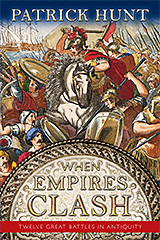
WHEN EMPIRES CLASH 2015
This military history text from Stone Tower Books (a new imprint of Lampion) takes a close and engaging look at twelve battles that shaped the ancient world and the imperial ambitions of ancient civilizations, including the Egyptians, Babylonians, Assyrians, Greeks, Persians, and Romans. These memorable, if not always decisive, battles include Qadesh (1274 BCE), Nineveh (612 BCE), Marathon (490 BCE), Issus (333 BCE), Trebbia (218 BCE), Cannae (216 BCE), Cartagena (209 BCE), Alesia (52 BCE), Actium (31 BCE), Masada (73 CE), Chalons (451 CE) and Tours (732 CE). Placing these battles in the larger contexts of the surrounding wars in which they were fought, the book focuses on the strategy and tactics of the military commanders who led these legendary battles, showing how they outwitted their enemies and innovated within the framework of ancient warfare.
The book also examines the propaganda campaigns waged by the various sides, which created dramatic narratives and cultural myths. These narratives and myths shaped perceptions of these battles during ancient times. But, in some cases, the battles continue to shape the cultural memory of these great battles up to the modern day.
New book release date is late December 2015. |
|
|
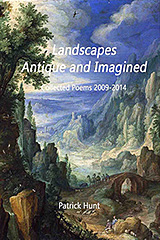
LANDSCAPES ANTIQUE AND IMAGINED 2014
Patrick Hunt’s fifth collection of poetry - in this case a hundred poems - follows his antiquarian and eclectic interests across history, art and music, mostly filtered through the meme of Classicism. At times lyrical, ekphrastic, and ironic, his influences range from Sappho and Martial to Coleridge and the Bible as well as Rabelais and Verlaine.
Landscapes have always inspired artists and poets, whether real or imagined, and journeys are remembered through time and space, from ancient sites to ekphrases of paintings, especially Flemish or Italian Renaissance imagery.
Poems include musings on artworks by Bruegel, Paulus Bril, Gozzoli, Grunewald and others.
Pirene Press, December 2014
ISBN: 978-0-578-15577-7
Buy this book soon at Corinthian / Pirene Press or Stanford Bookstore or at Amazon.com |
|
|
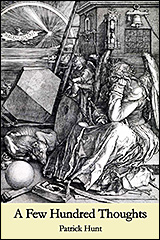
A FEW HUNDRED THOUGHTS 2013
A collection of 264 original aphorisms and fabulae (parables), inspired by Voltaire, Nietzsche and Kafka, these poetic, philosophical historical musings are distilled to their essence. Also unique tales about Alexander the Great, unusual museums, and fictive history in the vein of Borges and Umberto Eco.
From James Geary's blog, All Aphorisms, All the Time 2008: "Patrick Hunt is an archaeologist, writer, composer, poet, art historian—and damn fine
aphorist…He has a knack for making discoveries: In 1996, he found the 9,000-foot-high quarry for the Temple of Jupiter in the Fenetre de Ferret pass
adjacent to the Great St. Bernard Pass, and he directed a team that found a Roman silver coin hoard in the Swiss Alps in 2003. His aphorisms come from several different books, including Faust (1982), Proverbs (1989), and The Laws of Nature (2000).”
ISBN: 978-0-578-13533-5
December 2013
Buy this book at Corinthian / Pirene Press or Stanford Bookstore or at Amazon.com |
|
|
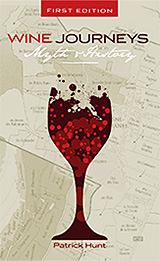
WINE JOURNEYS, MYTH & HISTORY 2012
This is a wine history from Anatolia to Europe covering 9000 years. In belle lettre and anecdotal form, this book shares wine journeys across multiple continents. It studies cultivation and purposes of wine and grapes and early agriculture since the Neolithic, also telling the myths of Dionysus and Bacchus from their Greek and Roman contexts. From Etruscans to Sicilians, from Roman legionaries to Charlemagne, from French monks across Bordeaux, Burgundy and Alsace, from the Rhine to the Rhone, from Tyrolean to Swiss vineyards, wine history is told with literary quotations and notes from the book of Genesis in the Bible to Homer, Virgil, Horace, Athenaeus, Chaucer, Rabelais and many other writers.
Hunt has taught postgraduate courses on the History of Wine at Stanford and elsewhere and has lectured at wineries, conferences, symposia and related venues around the world, including for the Napa Valley Vintners Association at Meadowood Resort in St. Helena, Napa Valley. He has traveled in wine journeys across five continents and annually spends time in viticultural regions in France and Italy as well as California.
Published by Cognella Academic Press, December, 2012
ISBN: 978-1-62661-064-4
186 pages 8x10
Buy this book at Cognella Academic Press or Amazon.com
|
|
|
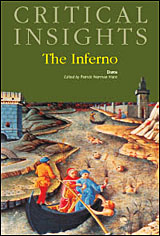
CRITICAL INSIGHTS, The Inferno 2012
Contributed original essays in this new book edited by Patrick Hunt include new work by Robert Harrison, Heather Webb, David Lummus, Nicole Rudick and Elizabeth Coggeshall. Patrick Hunt also contributed original essays and other material.
This volume is intended to make Dante's Inferno more accessible to inquiring students. Essays include a close reading of Dante, a chapter comparing and contrasting Dante's Inferno to his other writing, a history of the critical response to his work, and a chapter on the cultural and historical context of the poem.
Dante deserves a new reading with each successive generation, not because his poem evokes an obsolete Christian world or relic philosophy worthy of being curated in the museum of intellectual history, nor because he bridges several influential worlds long gone from view but still deeply rooted in our art, literature and common figurative language.
Dante is immortal partly because his epic poem distills more creative genius in the few decades it took to write than many cultures preserve of their legacy over millennia. Dante is at the very heart of Western Culture.
Published by Salem Press, September, 2011
Review:
"This series makes a valuable addition to academic libraries supporting literature students both at undergraduate and at graduate levels as it presents different views and more in-depth articles..." Library Journal
Editor: Patrick Hunt, Ph.D., University College London
ISBN: 978-1-58765-838-9
September 2012 · 1 volume · 360 pages · 6"x9"
Buy this book at Salem Press or at Amazon.com
|
|
|
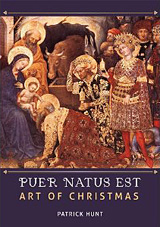
PUER NATUS EST: ART OF CHRISTMAS 2011
Seeing the Miraculous Through the Eyes of the Masters
The lavishly illustrated Puer Natus Est ("A Boy Child is Born" in Latin): Art of Christmas celebrates almost two thousand years of art on the theme of Advent. The book pairs artwork, mostly painting and other media like sculpture and mosaic, with narratives of the gospels and related literature. The written texts support the art and fill in perceived gaps in the story of Christ’s birth. The book begins with illuminated manuscripts from the medieval period and continues on through Giotto, Piero della Francesca, Gozzoli, Bellini, Botticelli, Raphael, Michelangelo, Pieter Bruegel the Elder, Caravaggio, Rembrandt, Georges de la Tour and many others. Included in the book are representations of the Annunciation, the Journey to Bethlehem, the Adoration of the Shepherds, the Nativity, the Journey of the Magi, the Dream of Joseph and other timeless themes from what many call the greatest story ever told. The Advent season has inspired some of the world’s finest art. Puer Natus Est: Art of Christmas gives us the opportunity to view the miraculous through the eyes of the great masters.
This book is a labor of love over ten years (at publisher since 2006) and has been shared in many Advent lectures since 2000.
New book by Patrick Hunt, released in December 2011 as just published by Cognella Academic Publishing. 220 pages, over 70 full color illustrations, 7 x 10 in. ISBN 978-1-60927-520-4.
Buy this book at Amazon.com
Also can be purchased directly from publisher Cognella or Stanford Bookstore or from Books Inc. in Burlingame.
Reviews:
Books, Inq. The Epilogue (The Sunday Times Top 100 Blog) Dec. 23
"A Lovely idea..." Frank Wilson
The Book Haven: Blog for the Written Word (Stanford) Dec. 23 "The art of Christmas: the voice of the people rather than the voice of the powerful" |
__________________________________________________________________________________
|
|
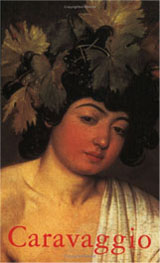
CARAVAGGIO (Life & Times Series) 2004
Born Michelangelo Merisi, as an adult he became known by the name
of his birthplace. Caravaggio (1571-1610) was the most
revolutionary artist of the Italian Baroque. Consistently emphasizing
the humanity of his religious subjects, he established a new way of
painting. The intensity of his chiaroscuro style is matched only by the
drama of his life. Outlaw, heretic, murderer, and sensualist were a few
of the charges brought against him by his contemporaries. Patrick
Hunt’s wide-ranging professional and personal scholarship allows him
to interpret Caravaggio’s complicated religious and classical imagery
while anchoring his art in his life.
CARAVAGGIO was shortlisted for the Saroyan International Prize 2005.
Published by Haus Publishing Ltd., London, U.K. in 2004
Buy this book at Amazon.com
The Art Newspaper, London, Dec 2004, "... first class ... a rattling good yarn"
The Independent, London, March 2005, "strong narrative"
The Times of London, March 2005,"... the book is one in a series of useful short biographies"
About CARAVAGGIO from MERCURY NEWS Ltd, Australia, "In Print Attitude", "Part of the Life and Times series, this superb biography is an excellent introduction to the most revolutionary artist of the late Renaissance. Hunt's grasp of the facts is firm and he never lets the melodrama of Caravaggio's life get out of hand."
|
_________________________________________________________________________________
|
|
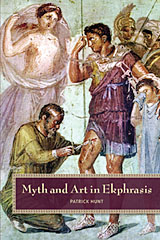
MYTH AND ART IN EKPHRASIS Fall, 2010.
This book is available at the Stanford Bookstore and Amazon.com!
Mythology has inspired countless generations of humanity for millennia, from the parent culture of a myth to cultures fairly removed in time, space and language. Poets, artists, historians and philosophers have interpreted the stories in many ways, and Greek and Roman myths in particular are rich in paradox and narrative wisdom that artists have also visually illustrated, often depicting the crux or dramatic climax of a story in close detail. Biblical material also provides a wealth of material for similar reinterpretations for artists or writers. Whether in language with figures like similes and metaphors, or in visual imagery from sculptures, mosaics, wall-paintings and other ancient media, retelling of mythology in parallel versions often borrow from each other and influence each other. For example, a wide range of artists including Dürer, Cranach, Rembrandt, Dore, Klimt, Waterhouse or anonymous ancient vase painters, mosaicists and sculptors reinterpret seminal texts of poets and thinkers such as Homer, Plato, Virgil, Ovid, Dante or biblical material.
Whether ancient or modern in its applications, Ekphrasis is an ancient Greek word that essentially has to do with literary versions inspiring visual artistic versions, or vice versa. Visual literacy can be as important as verbal literacy, and tracing these symbiotic influences and looking at their backgrounds are some of the primary foci of Patrick Hunt’s new book, Myth and Art in Ekphrasis.
Book released October, 2010 by Cognella Academic Publishing.
MYTH AND ART IN EKPHRASIS (Fall, 2010)
Buy this book at Amazon.com
|
__________________________________________________________________________________

|
|
REMBRANDT: His Life in Art 2006, 2007 2nd. ed.
This book is also available at the Stanford Bookstore!
Rembrandt van Rijn (1606-69) is the sublime and paradoxically familiar artist. Only the Greatest Masters and Geniuses of the first rank are easily called by one name. Yet even among these peers, few have the distinction of being household names and so often taken for granted as Rembrandt. Both the Romantic and Impressionist movements in art would be unlikely without him. Certainly the Baroque Era in which he lived emulated as well as eventually abandoned him within his poignant and troubled lifetime. Few artists are overshadowed by their own fame in their teens, only to be ignored in their old age like Rembrandt.
Which is the real Rembrandt? Genius, Curmudgeon, Master Engraver, Biblical Master, Hero Cult Figure, Vain, Miser, Greedy, Extravagant Spendthrift, Failed Businessman, Vindictive and Petty are just a few of the nouns and adjectives used to describe Rembrandt even in his own day. Perhaps all of these descriptions are “true” in one way or another. Although it would be impossible to prove many of these somewhat troubling descriptions, they are not necessarily contradictory. It must be one of the greatest paradoxes in art that Rembrandt, like Caravaggio before him, is known for being among the greatest of all religious painters while not being particularly outwardly religious. Rembrandt left no manual of his art, no revelatory journal of his life or handbook of his artistic techniques and very little correspondence has survived beyond little more than a handful of letters and a few brief notes, yet his work has profoundly influenced every generation of artists after him.
First released : Ariel Books, New York, November, 2006
Buy Now! Buy the book now at the Stanford Bookstore
REMBRANDT: His Life in Art, 2nd edition (2007) available.
Buy this book on Amazon.com
--- Reviews (April, 2008)---
"...Hunt sensitively considers how the circumstances of Rembrandt's
life affected his art...for specialists this book has some ideas worth
noting and that deserve to be more widely known...a highly readable
and accessible work for the general public and an unexpected source of insight for scholars..."
-- from the A.L.A. journal CHOICE (American Library Association)
|
_________________________________________________________________________________
|
|
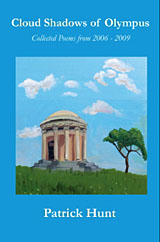
CLOUD SHADOWS OF OLYMPUS 2009
In Greek mythology, the Pirene Spring near Corinth was a place the winged horse Pegasus frequented and perhaps this spring even began when the hoof of Pegasus struck the rocky hill above the city. Pegasus in myth is associated with inspiration and the Muses.
The poems in this collection from 2006-2009 are mostly lyrical, many on mythological and Classical themes. Some have been published elsewhere, including in the Penguin Book of Classical Myths (2008) and in Akoué, a publication of the American School of Classical Studies, Athens in 2009 and likewise other poems have been published by the Classical Association of the U.K. in 2009, among other venues.
Cloud Shadows of Olympus: Collected Poems from 2006 - 2009 weaves a rich tapestry of classical imagery that transports the reader from the gates of Elysium to Cyrus’ garden at Pasargad and beyond. Drawing from an exensive knowledge of antiquity and its reception, the author presents a series of poems, each of which lovingly blends past and present. This lyrical collection of verses matches reollections of antiquity with a powerful evocation of a world that communicates to the sensory appreciation of the readers..
A Stanford first book reading and signing was celebrated at the Stanford University Bookstore, January 28, 2010.
Published by Pirene Press / Corinthian Publishing 2009
http://www.corinthianpress.com/index.html
Available December, 2009 onward at Stanford Bookstore, internet and soon on Amazon.com
|
___________________________________________________________________________________
|
|
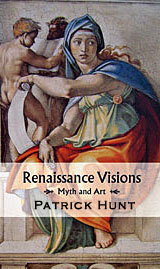
RENAISSANCE VISIONS: MYTH AND ART 2008
RENAISSANCE VISIONS: MYTH AND ART details selected ekphrases of great
painters such as Titian, Mantegna, Leonardo, Bruegel, Michelangelo,
among others, on myth. It explores the extensive background and
legend surrounding twelve favorite works of Renaissance art, such as
Botticelli's Birth of Venus and Caravaggio's Narcissus. Here are vivid
interpretations of these classic representations of Greek and Roman
myth, taking into account the ambiguity of the original stories and
the subsequent variety of perspectives on their meaning. In
conversational prose that invites the reader to delve into the book,
the book transports the reader into an era devoted to beauty and myth.
Available March, 2008 onward at Stanford Bookstore, internet and Amazon.com |
___________________________________________________________________________________
|
|
MYTHS FOR ALL TIME 2007
Timeless Greek myths retold as stories are never out of fashion. These
familiar tales form a priceless treasure that became one of the
foundations for Western culture, art and history. Without Greek myths,
our history, our imagination and our art would be that much poorer.
With these myths, we better understand our own time and place. Nearly
every great writer for thousands of years has somehow made direct
reference or alluded to Greek myths, incorporating some of the stories
into many an individual corpus of literature. These watershed myths
became vehicles for expressing some of our deepest ideas in metaphor.
Greek myths are essentially metaphysical stories where almost anything
can happen, unfolding in twists of plot that employ such universal themes
as hope, destiny, love, despair and judgment. In addition to
iconographic background and structural analyses, twelve selected myths
appear here told in the medium of short story with lively dialogue and
riveting action.
The myths selectively told in this book are Orpheus and Eurydice,
Midas' Golden Touch, Daedalus and Icarus, Narcissus and Echo, Heracles
at Olympia, Demeter and Persephone, Dionysus and the Pirates, Achilles
and Penthesilea, Apollo and Daphne, Oedipus and the Sphinx, Pandora's
Box and Endymion and Artemis
Book released Fall 2007 from Ariel Books, New York.
Buy this book on Amazon.com
|
___________________________________________________________________________________
|
|
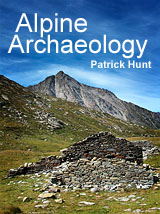
ALPINE ARCHAEOLOGY 2007
Alpine archaeology is a specialized field, where normal archaeological
principles apply (stratigraphy, pedology, data recording, anthropogenic
features, materials analyses, etc.) but where circumstances can be
considerably different. Higher altitude with a cold climate impacts
archaeological research and its practice in different ways, and they also
have bearing on the survival of materials, especially organic or metal
objects, which could be better preserved due to inhibited decomposition and
corrosion from less oxidation and lower diffusion rates. Montane soil and
soil chemistry may also be far more geologically-derived than produced by
plant decay. The spectacular find of the 5000 year old "Otzi the Ice Man"
is an illustration of some of this difference relative to temperate zone
archaeology, where his body was frozen in an glacial context for millennia.
This book mostly addresses the author's research in the Alps for over a
decade, conducted while directing the Stanford Alpine Archaeology Project.
Online previews of some of the chapters can be found below on Archaeolog, a
Stanford University internet resource.
Ariel Books, 2007, available at
the Stanford University Bookstore and on Amazon.com.
Buy this book on Amazon.com
photo © Marlin Lum
|
|
|
POETRY IN THE SONG OF SONGS 2008
Patrick Hunt has written a literary analysis of the Classical
Hebrew poetry in the biblical SONG OF SONGS - known in Hebrew as SHIR
HA-SHIRIM. Many figurative language devices in this
Hebrew poetry are annotated and examined (e.g., simile, metaphor,
paronomasia, euphemism, chiasmus, metonymy, synecdoche, hyperbole, etc.) and often compared to Classical
literature in applying the traditions of Aristotle and Quintilian, among others.
Patrick has also emphasized several obscure literary devices in Classical Hebrew not well published in prior literature
(note several articles of Patrick's previous publications with Peter
Lang Verlag in Frankfurt, BEATAJ - Beiträge zur Erforschung des Alten Testaments und des Antiken Judentums- Bands 20 & 28). Two of these
obscure literary devices are 'concealed paronomasia' and 'multiple sensory clusters'.
The ancient literary criticism does not appear to have known Hebrew names
for them. This new book on the dense, subtle and likely erotic Hebrew poetry
of the SONG OF SONGS suggests parallels to much of the world's most
beautiful poetry both before and after and offers compelling reasons why
this biblical poetry is so rich.
Peter Lang AG Publishing, Peter Lang Verlag - Vienna, Oxford, Frankfurt, Bern, Berlin, Bruxelles, New York
New book by Patrick Hunt, released in 2008.
Buy this book at Amazon.com
-- In Review of Biblical Literature (July 2009) by Prof. Stefan Fischer, University of Vienna:
"......[Hunt] makes a significant contribution with his studies on subtle wordplay and clusters of sensory images...an extensive study useful for those who are interested in literary figures and creative allusions of extrabiblical texts...The strength of the book is the great knowledge of the author drawing on many sources, especially classical ones, pointing to many allusions...."
|

 Read six poems excerpted from HOUSE OF THE MUSE Read six poems excerpted from HOUSE OF THE MUSE
|
|
HOUSE OF THE MUSE: Poems from the British Museum 2005
How do ancient works of art continue to inspire new art? The great poet
Keats must have seen panels of the Parthenon Frieze masterminded by the
Greek artist Pheidias in the new British Museum and probably wrote his
great poem "Ode on a Grecian Urn" from that inspiration. Some ancient myths
are so moving that every generation revisits them in new ways, including
music, art, literature, dance, theater and now cinema. We know Homer
inspired Virgil. Ovid inspired Titian. Titian
inspired Rembrandt. Rembrandt inspired Van Gogh, and so on. Inspiration is
not limited to themes or ideas and may sometimes be found in small objects
rarely seen or not always deemed major works.
Many know that a museum is a Temple to the Muses, especially the Muse of
History. This is a book of poetry about monuments and artifacts, some
large, some small. History. Archaeology. It is a reflective response to
these survivors of past cultures. Gathered from around the world and
sometimes well known for millennia, the individually selected subjects of
these poems have been looked at, walked around, and studied in various
light at different hours of day for years, encountered countless times by
many. They have stories to tell, not only the tales suggested here from the
most likely facts of ancient and even imaginary history as told and drawn by
an archaeologist-poet, but other stories many others could tell from similar
or different encounters.
These survivors belong not to one culture or time and place but to the world
and all of history. The poems here date over about a decade and have been at
times reworked and polished lovingly like lapidary stones. They are
dedicated to all lovers of history and art, but especially to those who
have curated and safeguard them, often for centuries.
 View Example Illustrations from 'House of the Muse' View Example Illustrations from 'House of the Muse'
Read six poems excerpted from HOUSE OF THE MUSE
This book is now available for sale from August 5, 2005 onward exclusively at
the Stanford Bookstore (by purchase online or in person) and from Iconoclast Books, Ketchum, Idaho (see website Links) from August 19 onward.
Buy this book at Amazon.com
Stanford bookstore : (650) 329-1217
Iconoclast Books in Sun Valley : tollfree (877) 726-1564
Published through Ariel Books, New York
Printed in Canada
|
|
|
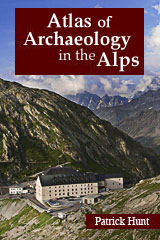
ATLAS OF ARCHAEOLOGY IN THE ALPS forthcoming 2016
Archaeology in the Alps is a topic of research covering millennia of
occupation and transit through these formidable mountains, from at least
the Mesolithic Era circa 9000 BCE when the European glaciers began to
sufficiently recede to allow hunting and temporary camps as well as stone
tool acquisition. With spectacular finds like "Otzi" the Ice Man in 1991,
Neolithic, Copper and Bronze Ages are followed by Iron Age (specifically
Hallstat and La Tene cultures) as well as the Celtic tribes concurrent with
Greek trade and early Roman expansion. Roman control of the Alps eventually
succumbed to Barbarian intrusions as in Langobard and Burgundian
occupation. Not since Ludwig Pauli's seminal 1984 study has a book
addressed the long record of human prehistory and history in the Alps,
although much archaeological material has been discovered since.
To be published by L'Erma di Bretschneider in Rome (ISBN pending),
will be available through publisher and
at Stanford University Bookstore.
Due out in 2016.
Learn and see how Cultural Heritage Imaging and the Stanford Alpine Archaeology Project worked together to digitally document Roman artifacts and objects from the collection Archeologique du Musee de l'Hospice du Grand St. Bernard.
|
| |
|
|
|
|
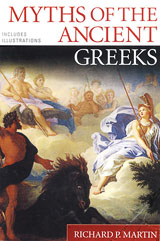
MYTHS OF THE ANCIENT GREEKS 2003
(Illustrations only by Patrick Hunt)
Richard Martin's 2003 book (New American Library/Penguin Books) fuses
dramatic retellings of myth expertly woven by Martin, noted mythologist,
with drawings by Hunt interspersed. Each of the 20 drawings is executed in
a style from Greek vases, either Black Figure or red Figure style. The
first of Hunt's gallery images linked here, the Death of Sarpedon as told
from Homer's ILIAD, was originally done by the Greek artist Euphronios (c.
510 BC) whose early Red Figure style Hunt has simulated in a line drawing.
The second of Hunt's gallery images linked here, Achilles and Ajax Playing
a Board Game, was orignally done by the Greek artist Exekias (c. 540 BC)
whose Black Figure style Hunt has also simulated in a line drawing. The
third of Hunt's gallery images linked here shows a Red Figure line drawing
simulation of a Classical Greek artist (c. 450 BC) portraying Gaia (Earth)
presenting Athena with the snake-child Erechthonios.
View Example Illustrations
Buy this book at alibris.com. |
|


















