 |
|
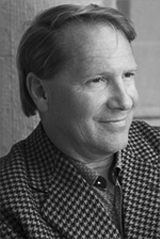
Patrick Hunt believes the perceived boundaries between academic subjects are too often arbitrary and artificial, and thus explores junctions between many intersecting areas of interest across the broader Humanities, sciences and the arts. If you were looking for Patrick Hunt as a young boy, you would have often
found him high up in a favorite tree with a book. He discovered Bach as a
young teenager and taught himself to play Bach’s TWO-PART INVENTIONS on a
rickety piano because his family could not afford music lessons.
|
Now his
love of teaching and creative ventures form a strong signature for his
life.
Patrick is indebted and grateful to hundreds of students young and old
over the years in many places who have taught him just as much as he has
taught them. He realizes how very lucky he is to be doing what he loves and
knows many people have helped him along the way.
Patrick has followed several of his life-long dreams – archaeologist, writer, composer, poet, art historian - for the last twenty years at Stanford University, starting as a Visiting Scholar in 1992 and teaching regularly since 1994.
Some of the courses he has taught at Stanford
accommodate his breadth of interests in the Humanities, the Arts, Ancient
History and Ancient Technology as well as Archaeological Science. He has
lived in London, Athens and Jerusalem as well as annual time spent in
Switzerland, France, Italy every year since 1994, among many other
countries, and has also conducted archaeological research in Spain and North Africa (Egypt and Tunisia) and in Peru on Inca
sites and on Olmec, Maya and Aztec cultures in Central America.
As a musician and composer, among classical music works, he has written
piano, choral and chamber and orchestral music and is a Full Writer member of ASCAP since
1980 when some of his choral songs were published along with a movie score
he composed. In 1999, a Duke University musical group performed his SONGS
OF EXILE: By the Rivers of Babylon in Washington, DC, Raleigh and at Duke.
Three arias from his opera in progress, BYRON IN GREECE, were
performed in London in March, 2005 and in Switzerland in 2006 and his several William Blake poems set to choral
music were performed at Stanford in February, 2005 and again in Palo Alto in 2007. He had new concert recitals in 2010, and including another concert by Duke University's Eric Meyers and George Gopen again performing SONGS OF EXILE in Durham on October 24, 2010. He also had a radio concert broadcast in 2011 on KZSU Stanford. In November, 2012, Patrick gave two solo music performances, one in Ephesus, Turkey, at the Roman Odeon of a flute piece, "Pegasus" and another instrumental premiere in Istanbul at the Byzantine 1001 Column Cistern, the "Dervish Dance"
from his other opera in progress, SULEIMAN THE MAGNIFICENT, where he accompanied a Sufi Whirling Dervish dancing to this music never before performed. It was recorded by Brazilian TV for impending broadcast in late 2012 - early 2013; a performance repeated in Istanbul in March of 2014.
Patrick illustrated Richard Martin’s MYTHS OF THE ANCIENT GREEKS (New
American Library-Penguin, 2003) and has illustrated his prior book of
poems, HOUSE OF THE MUSE: Poems from the British Museum, published in
the summer of 2005. His poetry publications include poems in YOUNG
AMERICAN POETS (1978), POET LORE (1978) and CLASSICAL OUTLOOK (1991), PENGUIN BOOK OF CLASSICAL MYTHS (2008) and AKOUÉ (2009), AETHLON (2009), and AMPHORA (2010), among many others. He is
also translating Greek poets like Sappho and encyclopedists like
Theophrastus and Roman epigrams from Martial. His 2009 published book of poetry was CLOUD SHADOWS OF OLYMPUS. In 2014 his most recent volume of poetry was just published, LANDSCAPES ANTIQUE AND IMAGINED.
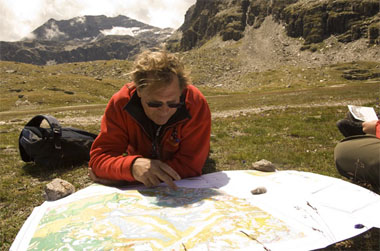
Patrick directed Stanford’s Alpine Archaeology Project between 1994-2012, continuing as the Hannibal Expedition. This project conducts high altitude research in alpine passes between Switzerland, Italy and France. In 1996 he found the 9000 ft. high quarry for the Temple of Jupiter in the Fenetre de Ferret pass adjacent to the Great St. Bernard Pass and directed a team that found a Roman silver coin hoard in the Swiss Alps in 2003. One of his primary research interests has been to track Hannibal who crossed the Alps in 218 BCE with an army accompanied by elephants. He has led annual teams across at least 25 Alpine passes in search of topographic clues matching the texts of Polybius and Livy who wrote about Hannibal nearly two millennia ago, including multiple Stanford teams between 1996 and 2014.
Patrick has been published on diverse topics such as monuments like the
Pantheon, ancient notables such as Gyges and Herodotus, linguistics,
biblical studies, Dante, the origin of Byzantine Silk, studies in Hebrew poetry
and literary wordplay, Martial's Latin epigrams, Roman monuments in operas, calendrical megaliths,
Gustav Klimt, Mozart, Olmec and Maya sculpture, iconography on Greek vases and myth palindromes,
Inca architecture, Carthage and nautical exploration, art history, Egyptian stone working and Phoenician
lore and topograhy and geoarchaeology, among other topics. His academic publications
include journal and encyclopedia entries in peer-reviewed articles
such as WORLD ARCHAEOLOGY (1989), BULLETIN OF THE INSTITUTE OF CLASSICAL
STUDIES, London (1988), PAPERS OF THE INSTITUTE OF ARCHAEOLOGY, London (1990),
STUDIA PHOENICIA (1991), BEITRAGE FUR ERFORSCHUNG DES ALTEN TESTAMENTS UND DES ANTIKEN JUDENTUMS (1992 & 1996), JOURNAL OF ROMAN ARCHAEOLOGY (1998), VOLCANOES, EARTHQUAKES
AND ARCHAEOLOGY published by the Royal Geological Society (2000), ACTA of
the XIIIth International Bronze Congress at Harvard University (2003),
ENCYCLOPEDIA OF THE ANCIENT WORLD (2003) and GREAT EVENTS IN WORLD HISTORY (2004), GREAT LIVES IN HISTORY (2008, 2009), Wiley- Blackwell ENCYCLOPEDIA OF ANCIENT HISTORY (forthcoming in 2011), AFRICAN ARCHAEOLOGY REVIEW (2009) and RENAISSANCE QUARTERLY (2007, 2008) and ENCYCLOPEDIA OF GLOBAL WARMING (2009), JOURNAL OF MILITARY HISTORY (2015) and MASTERPLOTS (2010). He has been an elected Fellow of the Royal Geographical Society since 1989,
named by the Biblical Archaeology Society to WHO'S WHO IN BIBLICAL STUDIES AND ARCHAEOLOGY (1993) and he has
also served as President of the Archaeological Institute of America’s
Stanford Society since 1995. Patrick's primary archaeology books of 2007 were titled
TEN DISCOVERIES THAT REWROTE HISTORY (Penguin-Plume) and ALPINE ARCHAEOLOGY (Ariel).
Along with monographs, novellas, and other writing, Patrick wrote
CARAVAGGIO, an art historical biography and critical book on the Baroque
genius painter, published in London in 2004. It has been highly acclaimed
in reviews including the ART NEWSPAPER International in London (December
2004) where it was described as “first-class” and “a rattling good yarn.”
He was invited to the Sun Valley Writers’ Conference in August, 2005,
where he presented the genre of new myth fable and again in August, 2008 on his book Ten Discoveries that Rewrote History and also on Ancient Olympics. His art history book on REMBRANDT: His Art and Life (Ariel) was out in second edition in 2007.
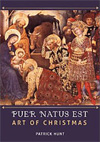
Patrick's selected books for 2008 included RENAISSANCE VISIONS: MYTH AND ART (Ariel). As mentioned, his book in 2009 was a book of poetry, CLOUD SHADOWS OF OLYMPUS: Collected Poems from 2006-2009. Patrick's 2010 book published is MYTH AND ART IN EKPHRASIS (Cognella Academic Publishing). His 2011 books include a book on Dante, CRITICAL INSIGHTS: INFERNO (Salem Press) and PUER NATUS EST: ART OF CHRISTMAS (Cognella Academic Publishing).
|
|

ELECTRUM MAGAZINE
Patrick Hunt is Editor-in-Chief of a new electronic magazine launched in December 2010.
|
|